Capable: When Anxiety Becomes a Family Problem
How anxiety can quietly reshape family life—and what helps families take it back.
By Courtney Bledsoe, LCSW | Courtney Bledsoe LCSW PLLC | Oak Park, IL
Parents usually come in talking about their child.
They’ll tell me their child seems far away lately — that the spark is gone, that the ease that used to be there has become something tenser. They’ll tell me about the things their child is struggling to do: falling asleep alone, going to school, staying in a room by themselves while a parent switches the laundry. Or they’ll tell me about everything their child needs: to be stayed with until they fall asleep, to have the same questions answered again and again, to have a parent pick up when they call from the school bathroom.
And in the middle of all of it, they tell me about their child. Not just the anxiety — but who their child actually is. The kid who can recite every statistic about their favorite team, or who makes everyone laugh at dinner, or who has a tenderness toward animals that still catches them off guard. They describe a child they love fiercely and know deeply.
And then, almost always, there’s a pause. Because the child they’re describing feels a little far away right now. The spark is still there — they know it is — but it’s been harder to see. What’s easier to see is the worry. The avoidance. The way a simple morning can unravel before it’s even started.
Most parents name sadness when they talk about this. Some name frustration. A few, quietly, name resentment. All of it makes sense.
They’re telling me a story about their child.
What I’m also hearing — and what usually isn’t visible to them yet — is a story about the whole family.
The Story Underneath the Story
Most of the parents I work with are doing more than they were a year ago. More staying. More reassuring. More adjusting. More managing.
They’re staying until their child falls asleep — because the alternative is a meltdown that goes until midnight. They’re answering the same worried question ten times because the eleventh time, finally, their child seems to settle. They’re skipping the birthday party, rearranging the morning, going upstairs with their child instead of sending them alone, adding one more book, one more cuddle, repeating the schedule one more time.
Each of these things makes complete sense.
And most parents haven’t stepped back to see the full picture — that they are doing more and more, that the list keeps growing, that the family peace has become something fragile that everyone is quietly working to protect.
That’s not a failure. That’s what love looks like when anxiety moves into the house.
Why Parents Get Pulled In
When children are scared and worried, they naturally look to their parents to help them feel safe. Of course they do. And parents — just as naturally — respond.
This instinct has been there since the moment your child was born. It’s wired into you. Your nervous system learned, through thousands of small moments, that when your child is distressed, you help. You soothe. You fix what you can fix. That’s not a flaw in your parenting. It’s the foundation of a secure relationship.
So when your anxious child is melting down at the door of a birthday party, or crying at bedtime, or calling from the school bathroom — of course you respond. Of course you stay. Of course you answer.
The hard part isn’t that parents are doing something wrong.
The hard part is that child anxiety has its own logic. And that logic is counterintuitive. And of course — how would a parent know that?
The Logic Most Parents Don’t Know About
Here’s what anxiety is doing underneath the surface.
When a child is scared and a parent steps in — skips the scary thing, provides the reassurance, stays until sleep comes — the parent is trying to communicate: you’re safe, I’ve got you.
But anxiety interprets that message differently.
To an anxious child’s nervous system, a parent who stays, soothes, and shields is also communicating something else — something no parent intends: this must really be dangerous. Even my parents are worried. They don’t think I can handle this.
The accommodation that was meant to help becomes evidence that the fear was justified. And next time, the anxiety comes back a little louder. Requires a little more. Pulls the family a little further in.
This cycle — described by Dr. Eli Lebowitz, the Yale researcher who developed the SPACE treatment approach — helps families see what is happening in these moments.
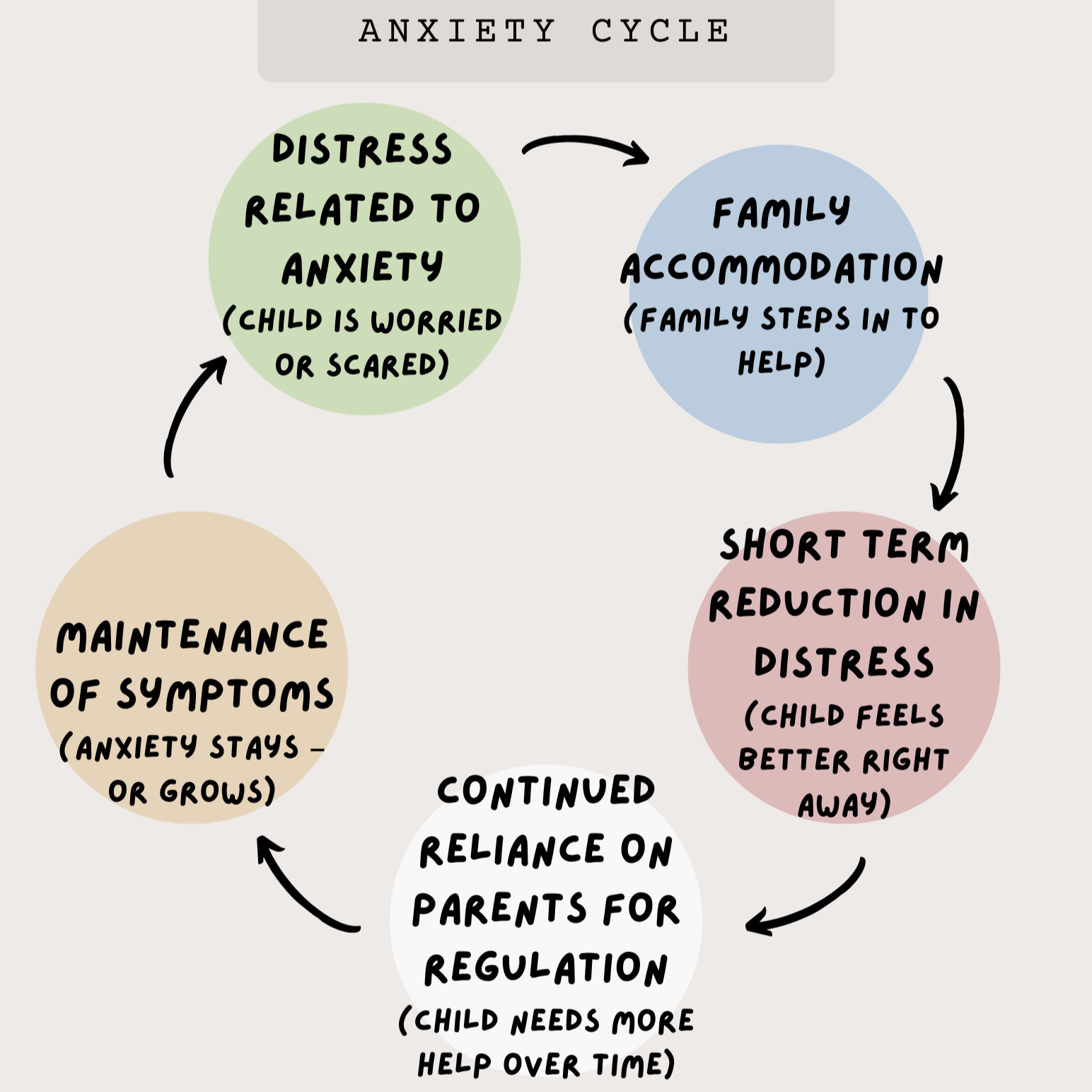
Accommodation Cycle, adapted from the SPACE treatment approach developed by Dr. Eli Lebowitz.
Each time the cycle completes, the anxiety doesn’t shrink — it gets a little more practice. And the family gets a little more organized around it.
This is how the list grows. This is why families find themselves doing more and more, even as the anxiety itself becomes more entrenched. Not because they’ve done anything wrong, but because they’ve been responding to their child with the instincts that work everywhere else — and anxiety requires a different approach.
What This Looks Like Across a Family
Once anxiety has its own logic explained, parents often start seeing their family differently.
They notice that a sibling has quietly learned not to make requests — that there isn’t room for their needs when everything is already so carefully balanced. They realize that they and their partner have been pulling in opposite directions for months: one pushing, one protecting, both convinced the other is making it worse.
They remember the vacation they cancelled — or maybe never even planned. The activities that quietly dropped away. The grandmother who keeps saying “just make him go” and the exhausting work of explaining, every holiday, why it isn’t that simple.
And they start to see what anxiety has taken from them, too. The yoga class they stopped going to because they needed to be home. The pickleball game they keep canceling. The friends they haven’t had over in months because the house doesn’t feel like a place where that’s possible right now. The work calls they’re stepping out of because their child is calling from the school bathroom — again. The mornings they’ve rearranged, the bedtimes that stretched so late that the dishes sat until midnight.
None of these feel like big losses in the moment. Each one seemed reasonable at the time. But added together, they tell a story — anxiety rarely stays in one place. It expands. It reorganizes. It becomes the silent scheduler of family life — deciding what gets attempted, what gets avoided, and who has to manage what.
The Goal Isn’t to Stop Helping
When families see this pattern clearly for the first time, the question that usually follows is: so what do we do? And the first worry is almost always the same.
When parents start to see this pattern, they sometimes worry that the answer is to become tougher. To stop responding. To let their child struggle. Many families have already tried this — drawn a line, held firm for a few days, and then watched everything fall apart. Hope isn’t a plan. What works is changing carefully and deliberately, with a clear sense of what you’re doing and why.
The goal isn’t to stop helping your child. The goal is to help in a way that sends a different message. Not I’ll make this safe for you — but I know this is hard, and I believe you can handle it.
Children need both parts of that. The understanding and the confidence. One without the other doesn’t work. Validation without confidence just confirms the fear. Confidence without validation feels like dismissal.
When parents learn to hold both at once — and learn to step back from the accommodations that have been quietly reinforcing anxiety — something shifts. Not overnight. Not without difficulty. But steadily, in a direction that feels different from the one the family has been heading.
What Change Actually Looks Like
Change is slow at first.
When families begin to shift these patterns, it doesn’t happen all at once. Parents are learning to respond differently in moments that are hard and fast-moving. Old habits don’t disappear overnight. There are good days and days that feel like backsliding. It can be hard, early on, to tell if anything is working.
But progress doesn’t stay slow. It accelerates.
Every time a parent responds with both validation and confidence — I know this is hard, and I believe you can handle it — something registers for the child. Not immediately, maybe. Not dramatically. But over time, those interactions accumulate. The child begins to have experiences of managing hard things. Of tolerating discomfort and discovering it didn’t break them. Of being seen clearly by their parent — not as fragile, but as capable.
That sense of competence grows. And it generalizes. The child who could eventually fall asleep alone starts to find that other things feel more possible too. The anxiety doesn’t vanish, but it stops being the only voice in the room.
There’s one more thing that often surprises parents: in this approach, the work belongs to them. Not because children don’t matter — they matter enormously — but because parents don’t have to wait for their child to be ready to begin. You don’t have to convince your child that therapy is a good idea, or that their fears aren’t real, or that they should just try harder. You just have to be willing to show up differently. And that, it turns out, is enough to start.
The goal isn’t a family without anxiety.
The goal is a family that is no longer organized around it — and a child who has learned, through lots of small moments with you, that they are more capable than the anxiety ever told them they were.
If any of this sounds familiar…
If you’ve been doing more and more and feeling like it’s helping less and less — you’re not alone, and you’re not doing it wrong. You’re just missing a piece of the picture.
If you’re in Chicago, Oak Park, the western suburbs or anywhere across Illinois and want to talk about what this looks like for your family, I’d love to connect. You can reach me here.
If you’ve been searching for a SPACE therapist, you may have noticed how few certified providers there are. I’m currently the only certified SPACE provider in Illinois. I’ve completed specialized, formal training in this approach, and working with anxious children and their families is the core of my practice — not one service among many. If you’re wondering whether this is the right fit, I would welcome a conversation and we can figure that out together.
And if you want to understand more about the approach I use to help families break this cycle, this post is a good place to start: What is SPACE Therapy?
Courtney Bledsoe, LCSW, is a therapist specializing in anxiety and OCD in children and adolescents in Oak Park, IL. She is the only certified SPACE provider in Illinois, offering in-person sessions in the Chicago area and western suburbs, and virtual sessions throughout Illinois. Her work focuses on helping families break the anxiety cycle — with or without the child in the therapy room.